Who Actually Works Here? Why Identity and Asset Drift Is the Quiet Risk in Growing Companies

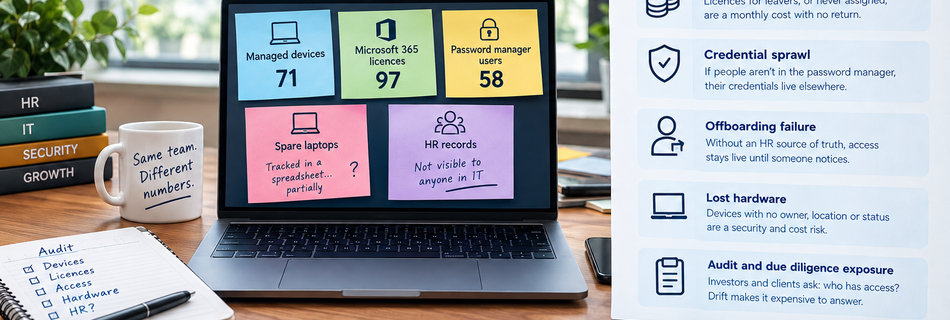
Ask a growing company a simple question: how many people work here? You’d expect one answer. In most audits I run, I get four or five. On a recent user access audit for a company of around 80 people, every system told a different story: None of these numbers is dramatic on its own. Together, …
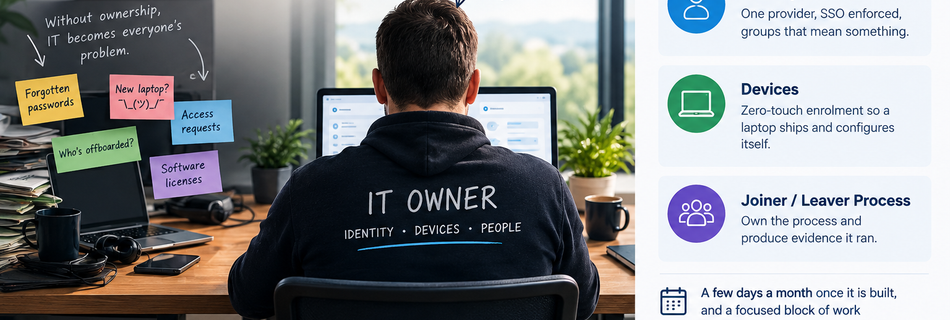

You do not need an IT Director

This is where most founders stall, and the reason is arithmetic. A full-time senior IT lead at 35 people is a significant salary for a role that, once built properly, is genuinely part time. Founders sense that mismatch. So the decision gets deferred, and the work keeps spreading sideways. But the choice is not between …

Five Years In: What 2021 to 2026 Taught Me About IT and Business

No milestone triggered this post. No anniversary, no big launch. Just five years behind me and enough distance to see the shape of them clearly. Here is what I learned, and where it came from. Tide: Building IT From Zero I joined Tide as employee 39. There was no exactly IT department to speak of.That …

The Leaver Who Still Had Access Three Weeks Later

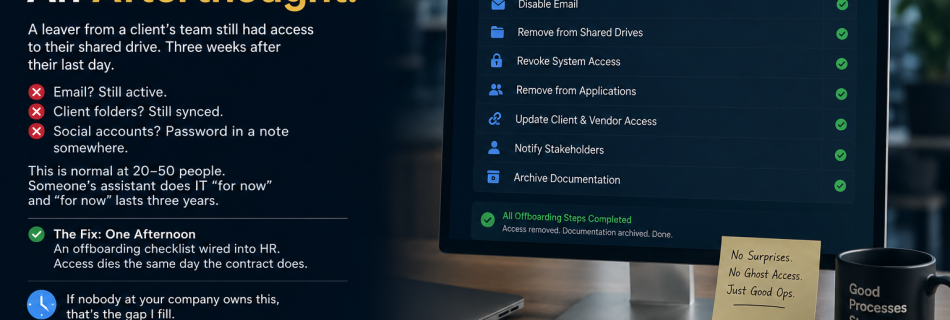
Someone left a company I support. Laptop handed back, farewell drinks done, name off the org chart. Three weeks later, their account was still active. Email working. Client folders still syncing to a personal machine. Their login still sitting in a password manager nobody had audited. Nobody did this on purpose. There was simply no …

Your IT Team Has Been Busy. But Has It Been Useful?

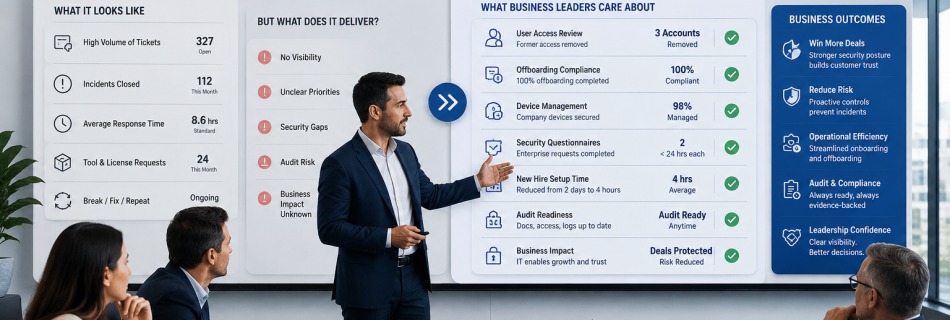
If you’re a founder, CEO, or COO running a company between 20 and 100 people, you’ve probably had this thought at some point: I have no idea what my IT person actually does all day. You see them in Slack. You hear about tickets being closed. You approve their tool subscriptions and licence renewals. You …

The Security Questionnaire That Kills SaaS Deals (And the 4-Week Fix)

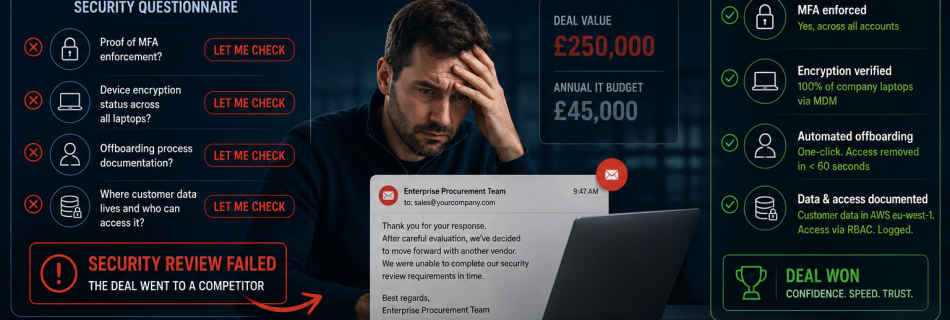
Scaling SaaS companies lose enterprise deals to security questionnaires they can’t answer. Here’s exactly what buyers ask, why “let me check” loses deals, and the 4-week fix that doesn’t require a full-time IT hire. Focus keyword: SaaS security questionnaire Your product is ready for enterprise customers. Your sales team has finally booked the meeting with …

Fractional IT vs Full-Time Hire: What Actually Makes Sense for a 20-100 Person Company

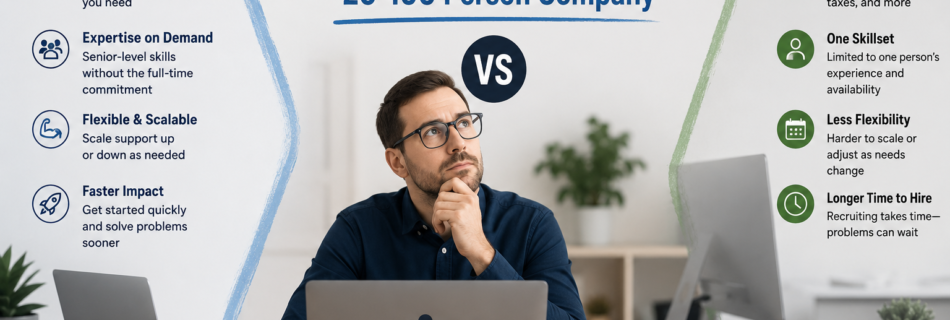
Introduction At some point in a company’s growth, IT becomes too important to ignore and too expensive to fully staff. This is the point where many founders either overhire — bringing on a full-time IT Manager before the workload justifies it — or underhire — giving the responsibility to someone whose primary job is something …

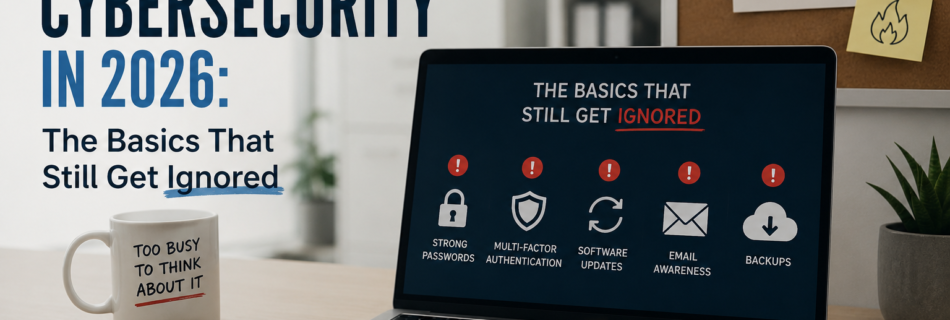
SMB Cybersecurity in 2026: The Basics That Still Get Ignored

Introduction Cybersecurity discussions at the enterprise level involve zero-trust architecture, SOC teams, and SIEM platforms. For a 50-person SaaS company, none of that is the relevant conversation. The relevant conversation is whether basic controls are in place — because in most cases, they are not. This guide covers the most common cybersecurity gaps I encounter …

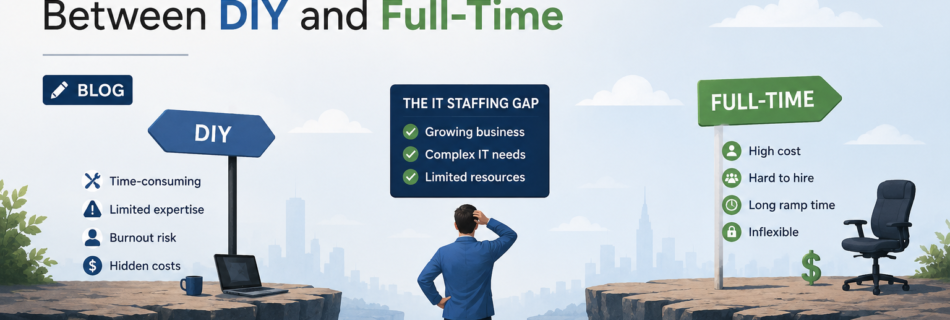
The IT Staffing Gap: Why Scaling SMBs Get Stuck Between DIY and Full-Time

Introduction There is a gap in almost every fast-growing SMB. It sits somewhere between 20 and 100 employees. The company is too big for the founder or office manager to handle IT on the side, but too small to justify hiring a full-time IT Manager at £50,000-65,000 per year. This gap is where IT problems …

GDPR and Your IT Stack: What You Actually Need to Have in Place

GDPR compliance is often framed as a legal problem — something for lawyers and data protection officers to worry about. And there is a legal dimension to it. But most of the practical work of GDPR compliance isn’t legal. It’s IT. It’s about knowing where personal data lives, controlling who can access it, and having …