
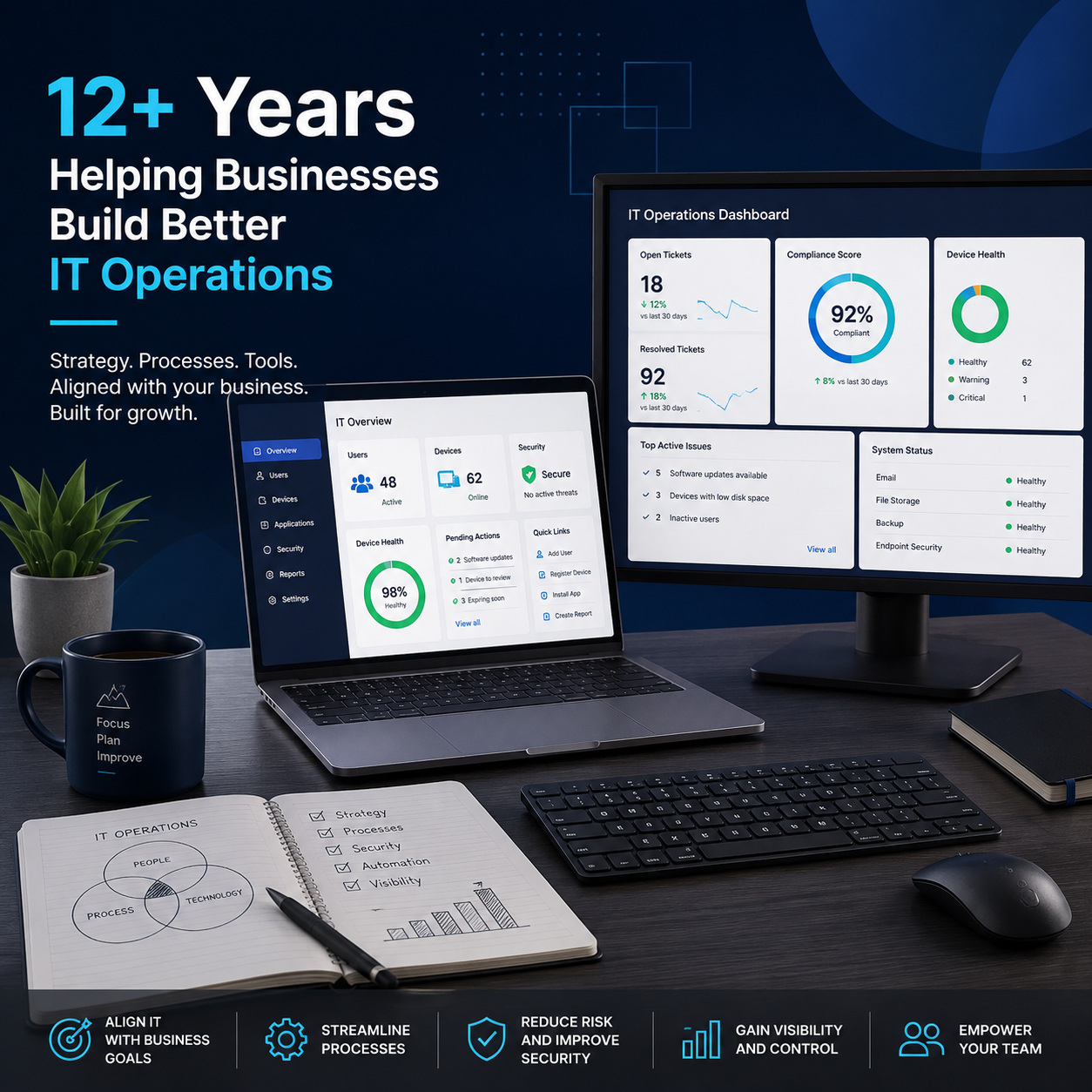
Every IT career looks tidy on a CV. Job title, dates, bullet points. What it does not show is the moment you inherit a system nobody documented, or the Friday afternoon when a company of 200 people discovers that the person who set up the domain left eighteen months ago.
This is the version with the useful parts left in.
Starting at the bottom, which turned out to matter
I began at Varchev Finance in Varna in 2014. Hardware, network administration, trading platform support. When a trader’s MT4 terminal went down, that was not a ticket, that was money moving without them.
Then BULPROS, on site at Coca-Cola Hellenic. First and second line support inside SLA. ServiceNow, Active Directory, Citrix, SAP, AirWatch. Enterprise IT at scale, from the bottom of it.
People treat these years as something to get past. I would argue the opposite. Everything I know about designing IT that actually works, I learned by being the person who had to make bad IT work anyway. You cannot fake that perspective later. Architects who never did support build systems that assume users behave reasonably. Users do not behave reasonably. They behave like people under deadline pressure.
HEINEKEN: what breaking things actually costs
2017 to 2019, IT Infrastructure Coordinator in Stara Zagora. A production environment, which means the consequences of an IT decision are physical. A server migration that goes wrong does not produce an error message, it produces a stopped line.
I migrated legacy servers to cloud and implemented centralised monitoring that cut incident response times by about 35%. But the real lesson was about sequencing and reversibility. In an office, a bad change means an annoying morning. In production, it means output you cannot recover.
That is where I learned to plan changes backwards from the rollback, not forwards from the deployment.
Tide: employee 39, and nobody else
July 2019. I joined Tide Business Banking as the thirty-ninth employee and the only IT specialist in the company. Over the next two and a half years it scaled past a thousand people across London, Sofia and Hyderabad.
There was no IT function. There was me, a growing list of new starters, and offices appearing in countries I had not been to.
What I built: multi-platform administration across macOS, Windows and Linux using Jamf Pro, JumpCloud and Intune. Network operations on Cisco Meraki, firewall and VPN across multiple sites. Access controls and compliance work aligned to ISO 27001 and SOC 1 and SOC 2. A full infrastructure migration that cut system maintenance time by around half. Hardware standards and lifecycle processes where none had existed.
The thing I did not expect to learn: at that growth rate, the constraint is never technical. Any competent engineer can configure an MDM. The constraint is that you are making decisions in month three that a company of a thousand people will still be living inside in year three, and you are making them alone, quickly, with no precedent.
Some of those decisions I would make differently now. Standardising hardware earlier would have saved months. Documenting as I went, rather than after, would have saved more.
SpotMe: doing it again, deliberately
2022 to 2023, Senior System Administrator at SpotMe. Event tech, over a hundred staff across the EU and US. IT operations built from the ground up, again, but this time knowing what I was building toward.
Standardised onboarding and offboarding cut new employee setup time by around 40%. Proactive documentation, monitoring and automation reduced downtime by a similar margin. Google Workspace as the primary collaboration platform for a globally distributed team, alongside Microsoft 365, Zoom, Slack and Atlassian. ISO 27001 and SOC 2 alignment from the start rather than retrofitted.
The difference between Tide and SpotMe was not skill. It was that the second time I knew which decisions would matter in eighteen months and which would not. That is the only real advantage experience gives you: knowing where to spend your attention.
Independent, since 2023
I now work as a fractional IT operations consultant for UK and EU companies, currently running full IT operations for a London agency with 52 devices across a distributed workforce. Google Workspace and Microsoft 365 administration, Mac fleet management via MDM, identity and access governance, endpoint hardening, and being the escalation point for infrastructure decisions.
The work is recognisably the same work. The companies are smaller. The gaps are identical.
What twelve years actually taught me
The tools are the easy part. I have worked with Jamf, Kandji, JumpCloud, Intune, Okta, Entra ID, Meraki, ServiceNow. They change. The underlying questions do not: who has access, what happens when someone leaves, is a new hire productive on day one, can you prove any of it to an auditor.
Almost every failure is an ownership failure. Not a technology failure. The MDM was fine. Nobody owned checking that enrolment stayed at 100%. The offboarding process existed. Nobody owned running it the day someone left.
IT becomes visible only when it fails. Which means well-run IT is structurally underappreciated, and the only fix is reporting the work in business language rather than ticket counts. Nobody outside IT knows what “we hardened the tenant” means. Everyone understands “three people who left last year still had access and now they do not.”
Companies between 20 and 100 people are where this breaks. Under 20, someone technical handles it part time and it works. Over 100, the volume forces a dedicated function. In between, the gaps accumulate silently, and they surface at the worst possible moment: a client security review, an audit, an enterprise deal where procurement asks a question nobody can answer.
Why I do this now
I spent years being the only IT person in companies that were growing faster than their infrastructure. I know exactly what that feels like from the inside, and I know what it costs when nobody is doing it.
Fractional IT operations exists because a company of 40 people has real IT needs and no business case for a full-time hire at the level those needs require. So they get someone senior, part time, who has built this before.
Twelve years, five companies, one recurring lesson. The tools change constantly. The gaps are always in the same place.
If your company sits in that 20 to 100 range and you cannot say with confidence who has access to what, that is the conversation worth having.
zlefterov.com