
Introduction
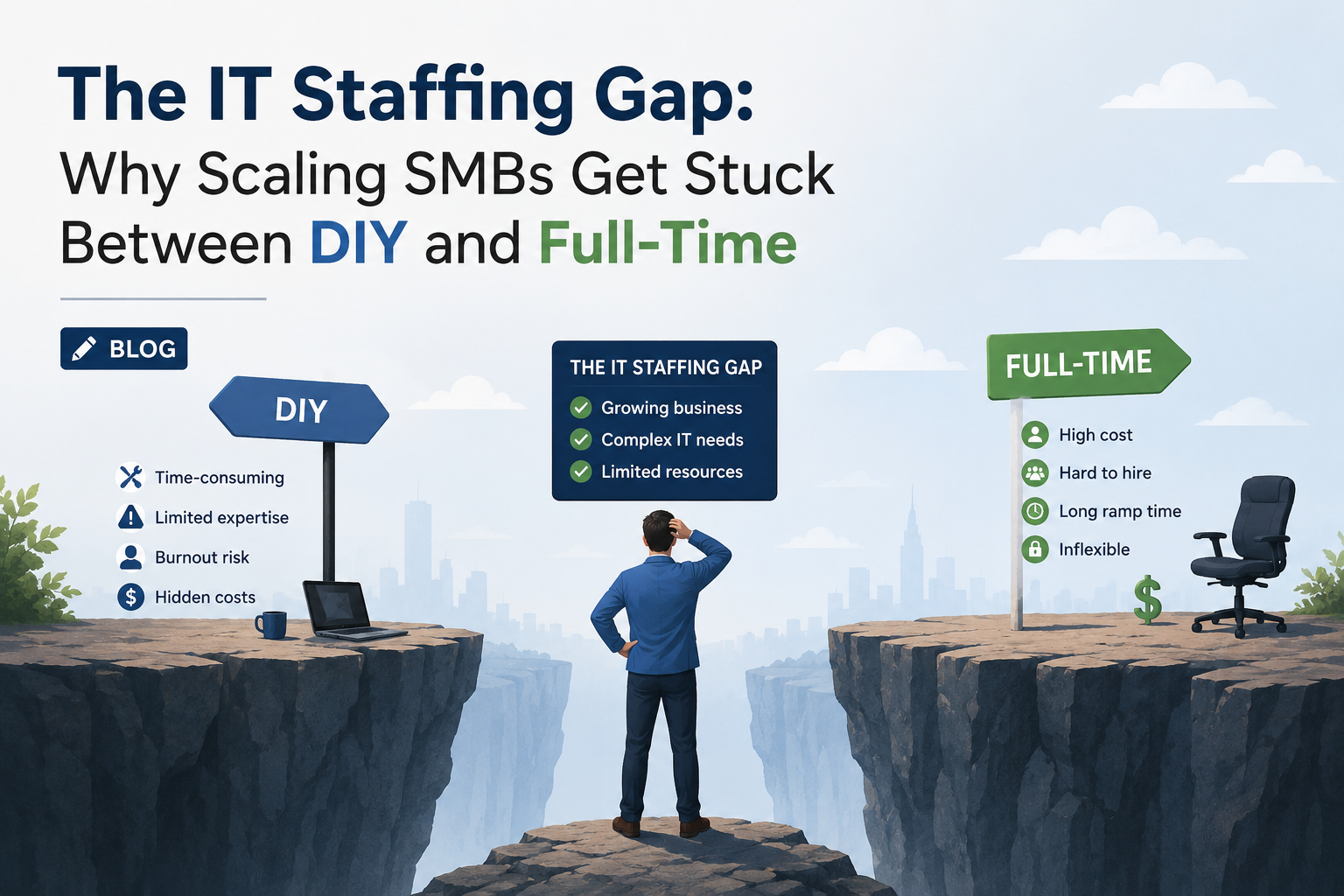
There is a gap in almost every fast-growing SMB. It sits somewhere between 20 and 100 employees. The company is too big for the founder or office manager to handle IT on the side, but too small to justify hiring a full-time IT Manager at £50,000-65,000 per year. This gap is where IT problems quietly compound — until they become very expensive.
In my 18 months running IT operations solo for a scaling UK company, I have seen this pattern play out in detail. This guide walks through what the gap looks like in practice, why it happens, and how fractional IT operations solves it.
What the Gap Looks Like in Practice
When a company hits 25-30 employees without dedicated IT, specific things start breaking down.
Onboarding becomes inconsistent
New employees join and receive access based on whoever set them up that day. One person gets a shared admin account because nobody had time to create a proper one. Another joins and waits three days for laptop access. A third gets permissions to a SharePoint folder they should never have seen.
In a real environment I managed, the onboarding process before I standardised it involved four different people across HR, ops, and the founder’s EA — none of whom had a documented checklist. Every new hire was a slightly different experience.
Offboarding is forgotten or incomplete
This is the most dangerous gap. When someone leaves, their accounts need to be disabled immediately. Their device needs to be wiped. Their email needs to be redirected or archived. Their access to Slack, Notion, LastPass, and every SaaS tool needs to be revoked.
Without a dedicated IT person, offboarding often means: disabling the Microsoft 365 account and calling it done. The former employee’s Slack account stays active. Their LastPass vault still contains company passwords. Their MDM profile is never removed.
I have personally found active accounts belonging to employees who left over a year prior — with full access to company data.
Tool sprawl accelerates
Without IT governance, tools multiply. Every team buys the SaaS product that solves their immediate problem. Nobody tracks licences. Nobody enforces SSO. Nobody removes users when they leave. A 50-person company I worked with had over 40 active SaaS subscriptions — 12 of which had no current owner and were still being billed.
Why Companies Stay in the Gap
The most common reasons are straightforward. A full-time IT hire feels premature — the problems are not visible enough to justify the headcount. Outsourcing to a large MSP feels expensive and impersonal. Internal promotions create IT leads who are competent at their original role but not at IT operations.
The result is that IT gets nobody, or it gets someone who was not hired to do IT.
How Fractional IT Operations Fills the Gap
Fractional IT means an experienced IT professional works with your company on a part-time or retainer basis. They act as your IT department — owning the tools, the processes, the security posture, and the day-to-day support — without the overhead of a full-time salary, benefits, and management.
The practical outcome looks like this:
- A documented onboarding checklist that works every time regardless of who triggers it
- An offboarding process that revokes access across every tool within hours, not days
- MDM coverage across all company devices with baseline security policies enforced
- A single person who knows the environment, owns the tooling, and can be reached when something breaks
What to Look for in a Fractional IT Partner
The most important quality is someone who has operated as a sole IT person in a real company environment. Consultants who have only worked in large IT teams often underestimate how different it is to be the only person — the one who gets the 9pm message when something stops working, the one who owns the MDM migration and the helpdesk ticket simultaneously.
Practical experience with the tools your company uses matters more than certifications. M365, Entra ID, Okta, Slack, Kandji, JumpCloud, Notion — these are the real stack of a modern SMB. Knowing how they interact is more valuable than theoretical knowledge.
Conclusion
The IT staffing gap is real, predictable, and solvable. If your company is between 20 and 100 people and IT feels like it is being held together with duct tape — that is not a people problem. It is a structure problem. Fractional IT operations gives you the structure without the overhead.
If this resonates with where your company is right now, visit zlefterov.com to start a conversation.