
If you’re a founder, CEO, or COO running a company between 20 and 100 people, you’ve probably had this thought at some point: I have no idea what my IT person actually does all day.
You see them in Slack. You hear about tickets being closed. You approve their tool subscriptions and licence renewals. You sign off on their hardware purchases. Occasionally something breaks and they fix it.
But if I asked you, right now, to tell me what your IT function delivered this month that moved the business forward, could you?
Most leaders I work with can’t. Not because their IT person is bad. Often quite the opposite. They’re working hard, putting out fires, keeping things running. The problem is that none of that work is visible to leadership in a way that connects to business outcomes.
This is the IT visibility gap. And it’s costing you more than you think.
What the IT Visibility Gap Actually Looks Like
Here’s what I see in companies between 20 and 100 people, almost without exception.
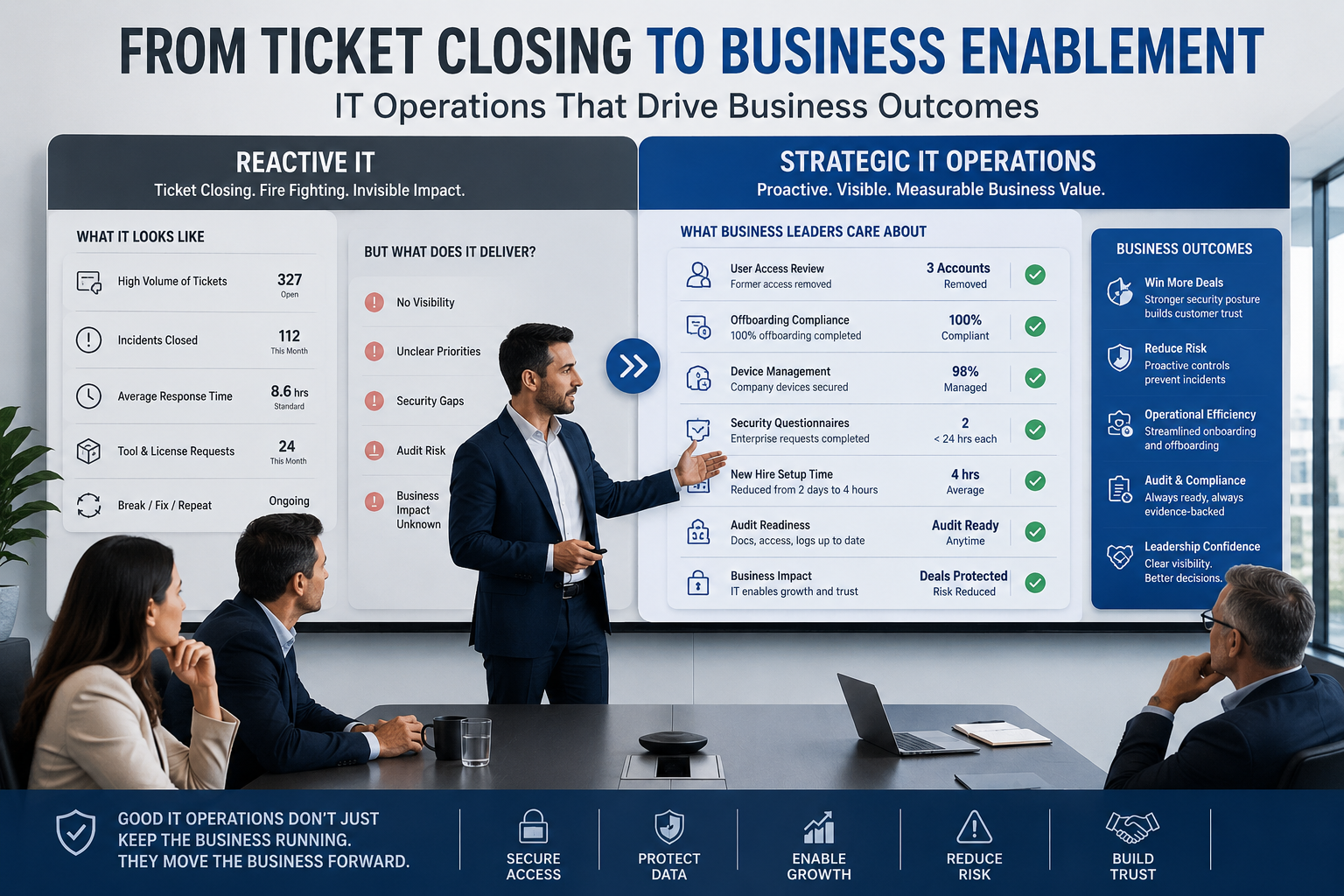
The IT function is reactive. Tickets come in, tickets get closed. The metric of success is “how many tickets” or “how fast were they resolved.” Neither of those numbers tells you whether your business is more secure, more efficient, or better prepared than it was last month.
Meanwhile, real problems are accumulating quietly in the background. Former employees still have active accounts six months after they left. New hires take two days to get fully set up because nobody documented the onboarding process. The Slack workspace has external sharing enabled by default and nobody noticed. The MDM solution covers laptops but not the contractor devices that have access to client data.
None of these issues show up on a ticket report. None of them get flagged in a weekly standup.
They only become visible when something goes wrong a security incident, a failed audit, a customer asking a question your team can’t answer.
Why This Matters to the Business
If you’re a CEO or COO reading this and thinking “this sounds like an IT problem, not my problem,” I’d push back.
This is your problem the moment any of these things happen:
A customer or prospect asks for a SOC2 report or completed security questionnaire, and your team scrambles for two weeks to assemble answers that should have been ready to send the same day.
An enterprise sales conversation gets derailed because the procurement team needs evidence of access controls, device management, or data handling practices, and you can’t produce them.
A regulator or auditor flags gaps in your offboarding process, your access logs, or your incident response plan, and you’re suddenly explaining to your board why this wasn’t caught earlier.
A former employee retains access to systems they shouldn’t, and either intentionally or accidentally causes damage that should have been impossible.
Each of these scenarios has a direct business cost. Lost deals. Failed audits. Regulatory fines. Reputational damage with partners. And every one of them traces back to the same root cause: IT operating as a fix-it function rather than a strategic one.
What Good IT Operations Looks Like Instead
The companies that don’t have this problem aren’t running larger IT teams. They’re running IT differently.
The difference is that someone in the business owns these questions:
Who has access to what, and is it documented?
When someone joins or leaves, what happens, and how long does it take?
What devices have access to company data, and are they secured?
If a customer or auditor asks about our IT and security posture, can we answer immediately?
What did IT actually deliver this month that improved the business?
That last question is the one most companies fail. Not because the work isn’t being done, but because nobody has been asked to translate IT activity into business language.
When IT is set up properly, every month you get a clear report that looks something like this:
This month we identified three former employees with active accounts and revoked them. We reduced new hire setup time from two days to four hours. We caught a Slack setting that was sharing files externally by default and corrected it. We completed the device inventory and 98% of company devices are now under management. We responded to two security questionnaires from enterprise prospects in under 24 hours each.
That’s a report a board, a leadership team, and a customer can all understand. It’s a report that builds confidence rather than questions.
The Pattern I See in 20-100 Person Companies
After more than 10 years across IT roles, from hands-on helpdesk through systems engineering to ops leadership, and after building or rebuilding IT functions from scratch at SaaS and fintech companies, the pattern is consistent.
Companies under 20 people don’t have an IT function, someone technical handles it part-time and it works fine.
Companies over 100 people usually have a dedicated IT or IT operations leader because the volume forces the issue.
The 20-100 person window is where things go wrong quietly. The company has grown beyond what part-time IT can handle, but not enough to justify a full-time hire at the leadership level. So the gaps accumulate. The visibility disappears. And by the time something forces the issue – usually a failed audit or a lost deal, there’s six to twelve months of cleanup work that should have been distributed across that period.
What This Costs You
I’ll be direct. Companies that don’t address this proactively pay one of three prices.
They pay in lost deals when enterprise prospects look at their IT posture and walk away.
They pay in failed or delayed audits that cost three to six months of executive time to remediate.
They pay in incidents, small or large, that should have been impossible if access controls and offboarding had been done properly.
In every case the cost is significantly higher than addressing it as a regular ongoing function would have been.
What I Do
I work with SaaS and fintech companies between 20 and 100 people as a fractional IT operations consultant. The role is straightforward: I find the gaps in your current IT setup, close them, and make sure your IT is never the reason a deal falls through, an audit gets flagged, or a partner loses confidence in your operation.
Every engagement starts with a clear assessment of where things stand today, followed by a prioritised plan, followed by monthly reporting that you can take directly to your board or leadership team.
If you’re reading this and recognising your own situation, the next step is a 30-minute conversation. No commitment, no pitch deck, just a clear read on whether what I do matches what your company needs.
…also feel free to get the free IT assessment report with my tool -> https://ITops.zlefterov.com
Thanks for your time
Don’t be a stranger – say “Hi” zlefterov.com