
Introduction
At some point in a company’s growth, IT becomes too important to ignore and too expensive to fully staff. This is the point where many founders either overhire — bringing on a full-time IT Manager before the workload justifies it — or underhire — giving the responsibility to someone whose primary job is something else entirely.
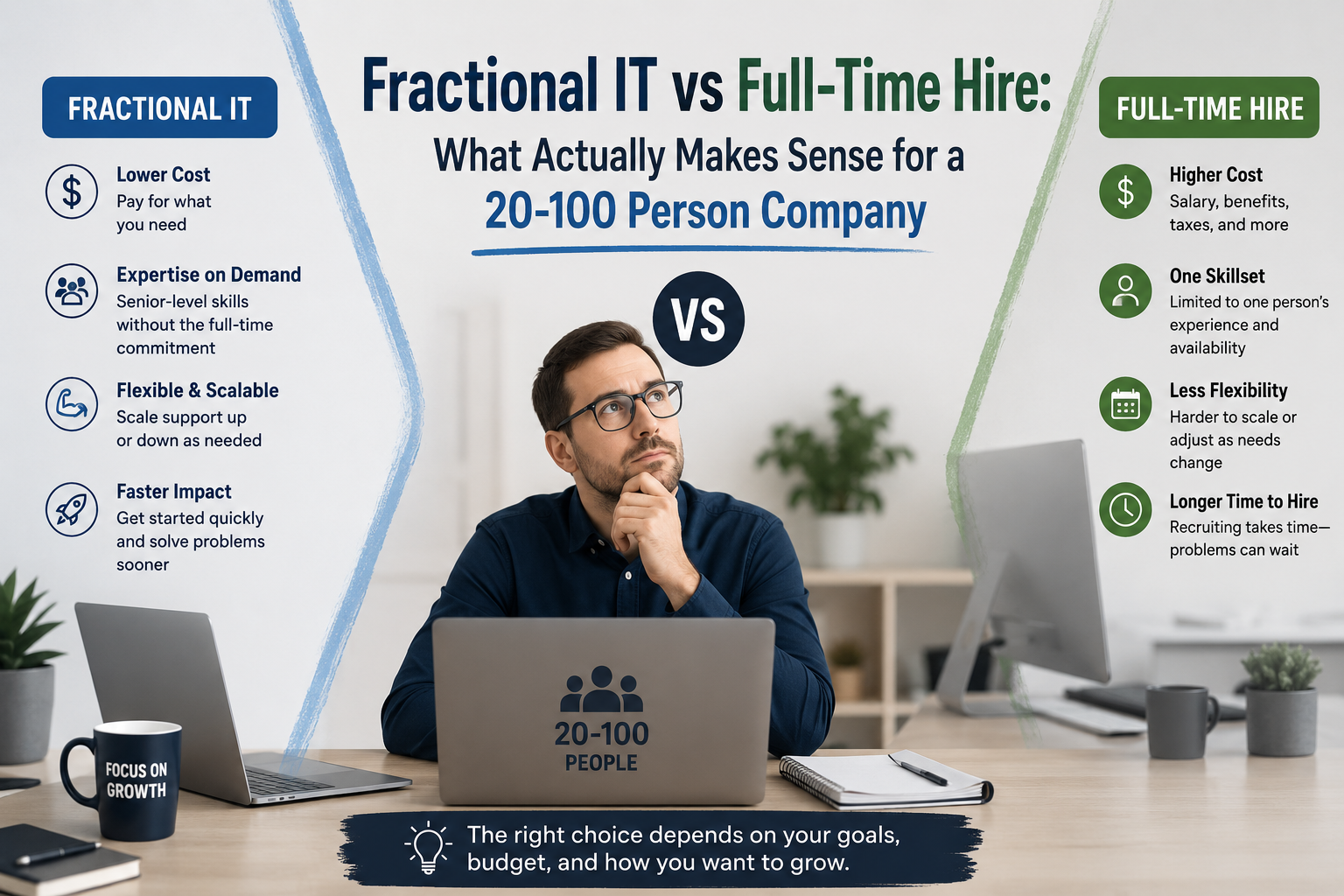
Fractional IT is a third option that fits the reality of most SMBs between 20 and 100 employees. This guide compares the options honestly.
The Real Cost of a Full-Time IT Hire
A mid-level IT Manager in the UK commands £45,000-65,000 per year in base salary. Add employer National Insurance contributions, pension contributions, hardware, software licences, and recruitment costs – typically 15-20% of first-year salary – and the true first-year cost is closer to £70,000-85,000.
For a 50-person company generating £3-5M in revenue, this is a significant overhead. More importantly, a single IT Manager at this scale often spends a large portion of their time on reactive support – helpdesk tickets, password resets, access requests – rather than the strategic work the hire was intended for.
The Hidden Cost of No IT
The alternative – having no dedicated IT – has costs that are harder to see but equally real. Inconsistent onboarding wastes hours of HR and manager time for every new hire. Unmanaged devices create security exposure. Tool sprawl wastes budget. Security incidents, even minor ones cost far more to remediate than to prevent.
The ops manager or office manager who absorbs IT responsibilities alongside their primary role does both jobs worse as a result. This is a hidden cost that rarely appears in a budget but is real in its impact.
What Fractional IT Actually Delivers
Fractional IT means an experienced IT professional works with your company on a retained basis, typically the equivalent of a few hours per day owning the environment, running the processes, and being available when things go wrong.
The scope is the same as a full-time hire: MDM, identity management, onboarding and offboarding, security posture, SaaS governance, helpdesk support. The difference is the cost structure and the flexibility.
What you should expect from a fractional IT arrangement
- A single named person who owns and understands your entire IT environment
- Documented processes for onboarding, offboarding, and common support tasks
- Proactive security management, not just reactive ticket resolution
- Availability during business hours for urgent issues
- Regular communication on IT health, upcoming risks, and recommendations
When to Move to a Full-Time Hire
Fractional IT is not the right structure forever. As a company grows past 100-150 employees, the volume of support work, the complexity of the environment, and the need for in-person presence typically justifies a full-time hire. The transition is easier when fractional IT has built solid foundations, documented processes, clean tooling, and a well-governed environment for the full-time hire to inherit.
Conclusion
For most companies between 20 and 100 employees, fractional IT is not a compromise it is the appropriate structure for the stage. It delivers the coverage and expertise of a full-time hire at a fraction of the cost, with the flexibility to scale as the company grows.
https://ITops.zlefterov.com -> eye opening tool
https://zlefterov.com -> the IT pain killer place