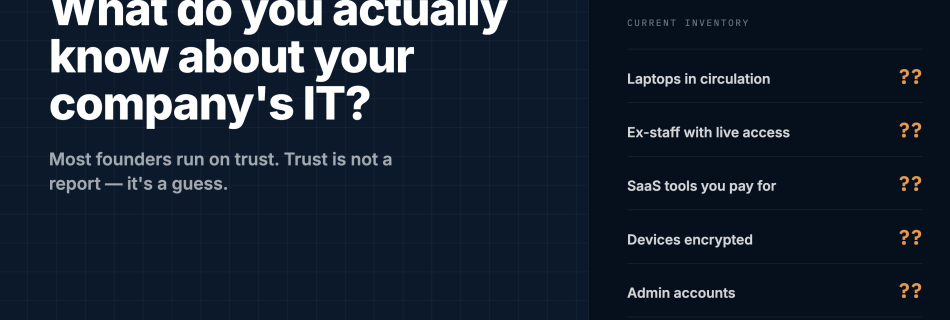
Nobody had written down how people join and leave

I support IT for a London agency of about 60 people. Macs, Microsoft 365, Slack, identity in Entra ID. The tools were fine. The problem sat between them. What I found Joining and leaving the company was not written down. It worked because the right person happened to remember. That holds at 20 people. It …

Twelve Years in IT Operations: What I Learned Building It Five Times

Every IT career looks tidy on a CV. Job title, dates, bullet points. What it does not show is the moment you inherit a system nobody documented, or the Friday afternoon when a company of 200 people discovers that the person who set up the domain left eighteen months ago. This is the version with …

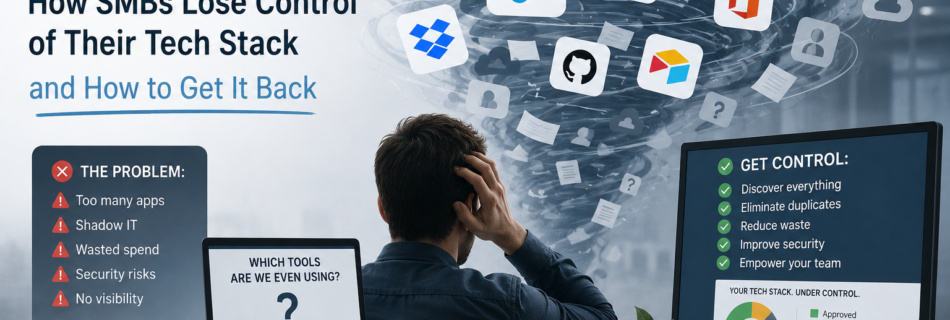
SaaS Sprawl: How SMBs Lose Control of Their Tech Stack and How to Get It Back

Introduction SaaS adoption has removed the friction from buying software. Any team member with a company card can spin up a new tool in minutes. This is genuinely useful for moving fast – and genuinely dangerous for IT governance, security, and cost management. This guide covers how SaaS sprawl develops in growing SMBs, what it …

What Good IT Actually Looks Like at 50 People (And How to Get There)

There’s a version of IT at a 50-person company that most founders have never seen — not because it’s rare in successful companies, but because when IT works well, it’s invisible. Nobody notices that the new hire’s laptop was ready before they arrived. Nobody notices that the former employee’s access was removed within an hour …

IT Debt: What It Is, How It Accumulates, and How to Pay It Off Without Disrupting Your Team

Software engineers are familiar with technical debt — the accumulated cost of shortcuts, quick fixes, and deferred improvements in code. The debt doesn’t cause problems immediately. But it compounds. And eventually, paying it down becomes unavoidable. IT operations has the same dynamic. I call it IT debt. What IT Debt Looks Like IT debt is …

When Offboarding Goes Wrong: A Security Story Every Founder Should Read

I’m going to tell you a story. The details have been changed to protect the company involved — but the sequence of events is real. A 45-person SaaS company. Good team, strong culture, growing fast. A developer resigned after three years — no bad blood, they were going to a larger company. The notice period …

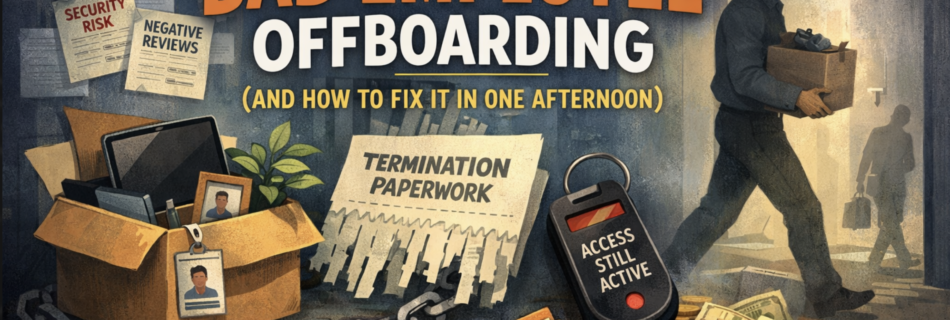
The Hidden Cost of Bad Employee Offboarding (And How to Fix It in One Afternoon)

Most companies have an onboarding checklist. Someone thought carefully about first impressions, set up accounts, ordered a laptop, and made sure the new hire felt welcome on day one. Almost none of those same companies have an offboarding checklist. And that asymmetry is costing them — in ways that don’t show up on a spreadsheet …

When IT Stops Scaling With Your Business

Most startups and small businesses don’t fail because of bad ideas. They struggle because operations don’t scale at the same pace as growth — and IT is usually the first place where friction appears. If your company has 15–50 people, works remotely or hybrid, and is growing steadily, this may already sound familiar. The hidden …

Slack Channel Archiving: A Practical Guide to Clean, Calm, and Scalable Collaboration

Modern teams accumulate communication noise faster than they realize. Projects end, clients churn, pilots fail, and internal initiatives change direction—yet Slack channels often remain open indefinitely. The result is clutter, confusion, and decision fatigue. Channel archiving in Slack is one of the simplest but most underused controls for maintaining operational clarity. This article explains what …