
For many startups, SOC 2 becomes a requirement the moment they begin selling to larger companies or enterprise customers.
Suddenly, a deal depends on passing a compliance audit.
The common reaction is to look for security tools.
More monitoring.
More dashboards.
More vendors promising compliance automation.
But after working with growing teams, one pattern appears repeatedly:
Companies rarely fail SOC 2 because they lack tools.
They fail because their IT operations are not structured enough to support compliance.
SOC 2 is fundamentally an operational maturity test.
Below are three of the most common reasons startups fail their SOC 2 audits.
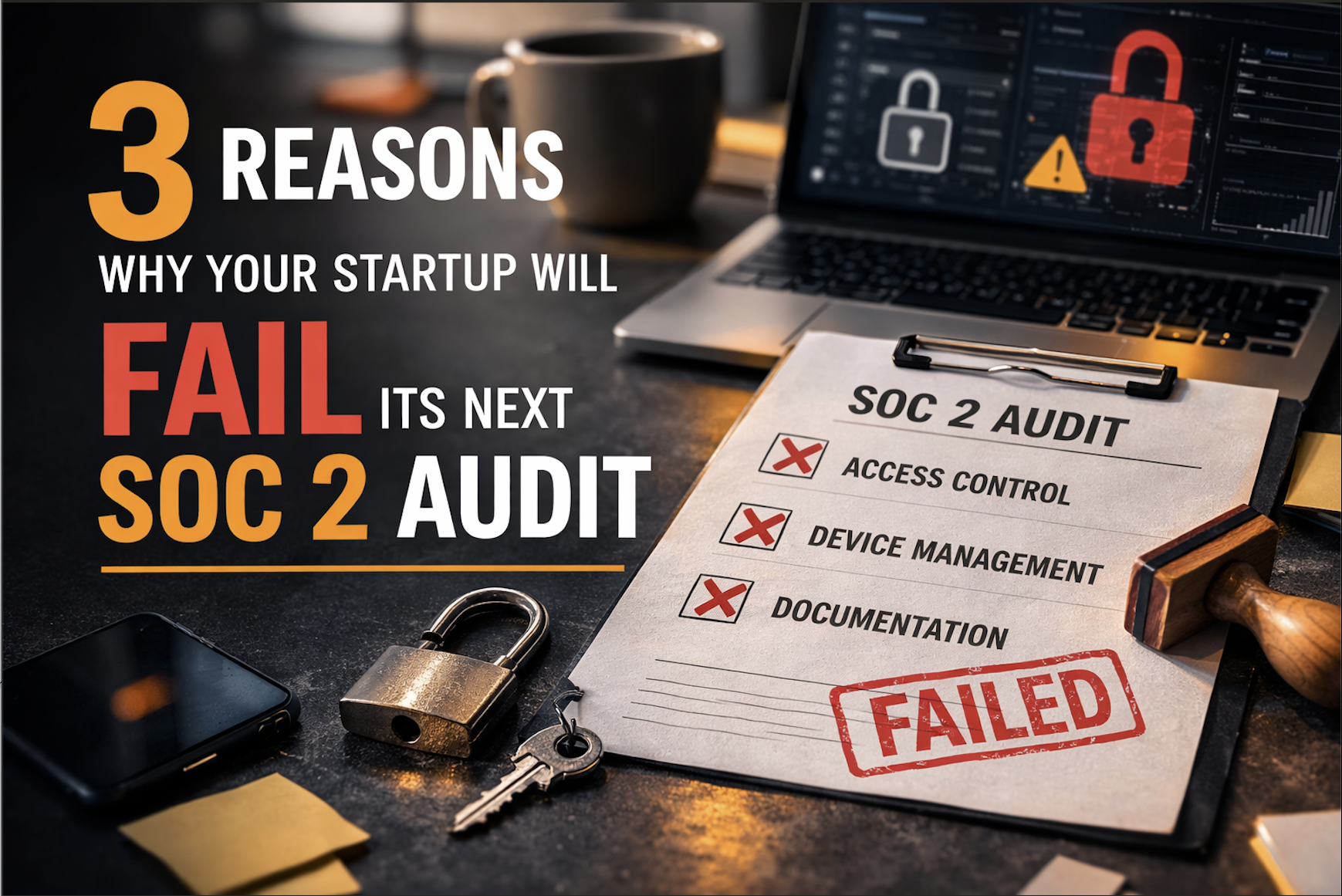
1. Lack of Access Governance
One of the first things SOC 2 auditors examine is how access to systems is granted, reviewed, and revoked.
In early-stage startups, access control often evolves organically:
• engineers share credentials
• Slack messages approve access
• employees receive admin rights by default
• offboarding happens manually and inconsistently
From an operational standpoint, this creates multiple risks:
• unauthorized access
• privilege escalation
• orphaned accounts
• lack of traceability
SOC 2 requires companies to demonstrate structured access management, including:
- documented access request procedures
- manager approval workflows
- role-based access controls
- periodic access reviews
If an auditor cannot clearly see who approved access and why, the control will fail.
2. Unmanaged Endpoints
Modern startups are often remote-first.
Employees work from home, coworking spaces, and different countries.
Without centralized device management, organizations quickly lose visibility into the security posture of employee devices.
Typical situations auditors encounter include:
• laptops without enforced encryption
• inconsistent OS patching
• personal devices accessing company systems
• no centralized device inventory
SOC 2 requires companies to demonstrate they maintain security controls over endpoints accessing sensitive data.
This usually means implementing:
- Mobile Device Management (MDM)
- security baselines
- patch management policies
- remote lock and wipe capabilities
When devices are unmanaged, auditors cannot verify that company data is properly protected.
3. Missing Operational Documentation
The third major issue is surprisingly simple: lack of documentation.
Many teams operate effectively day-to-day, but processes exist only in people’s heads.
During SOC 2 audits, companies are asked to provide evidence for processes such as:
• employee onboarding
• access revocation
• incident response
• change management
• vendor risk management
If these procedures are not documented, they cannot be validated.
SOC 2 does not assess whether a company could respond correctly to an incident.
It assesses whether the company has documented procedures proving it consistently does.
Documentation transforms operational knowledge into auditable controls.
SOC 2 Is an Operations Problem
One misconception about SOC 2 is that it is primarily a security tooling exercise.
In reality, SOC 2 measures something deeper: the maturity of a company’s operational practices.
Organizations that pass audits smoothly usually already have:
- structured IT operations
- clear access governance
- managed devices
- documented procedures
Companies that try to implement these structures during the audit process often struggle.
Final Thoughts
SOC 2 should not be viewed as a compliance burden.
When implemented correctly, the controls required for SOC 2 also create a more secure and scalable IT environment.
The earlier startups build operational structure, the easier compliance becomes.
And the stronger their internal systems will be as they grow.
If you’re a startup preparing for SOC 2, the most valuable step is not buying another tool.
It is ensuring your IT operations are structured enough to support compliance.