
Small and growing businesses rarely think they have an IT problem.
Systems work.
Emails send.
Files sync.
Employees log in.
So everything must be fine.
But operational IT risk doesn’t show up as noise.
It shows up as delayed growth, hidden inefficiency, and sudden disruption.
And by the time it becomes visible, it’s already expensive.
IT Is No Longer “Support.” It Is Business Infrastructure.
In modern companies:
• Identity = security perimeter
• Devices = data gateways
• Cloud tools = operational backbone
• Access control = risk management
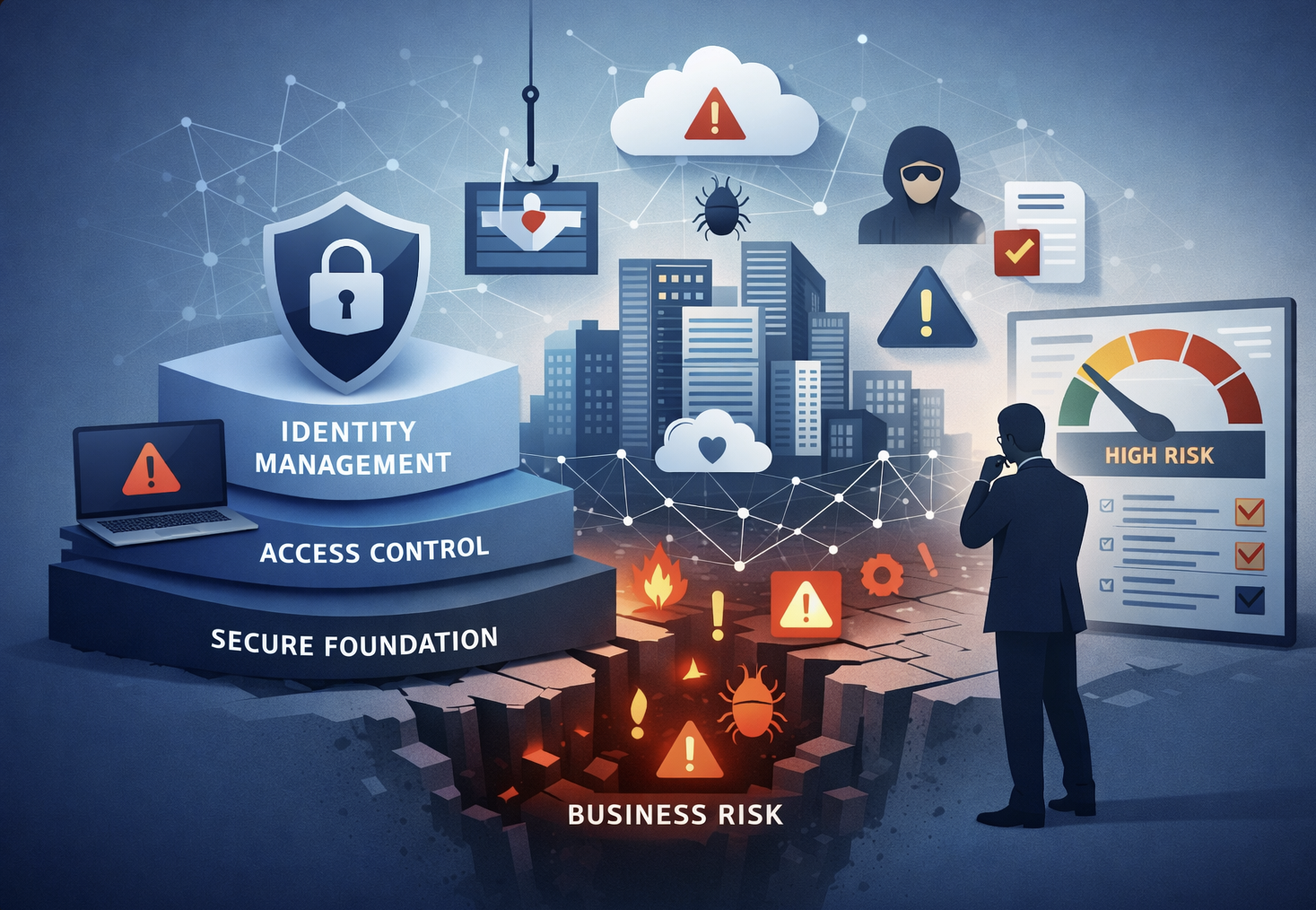
If these are not structured, the business is operating on informal processes.
Informal processes don’t scale.
What I See in Growing SMBs
Across startups and SMB environments, the same patterns repeat:
• Access granted manually without lifecycle control
• No structured offboarding process
• Shared admin accounts
• Conditional Access either misconfigured or missing
• Device compliance not enforced
• Documentation fragmented or outdated
• No periodic access reviews
• Reactive security approach
Nothing seems broken.
But the foundation is unstable.
The Hidden Cost of “We’ll Fix It Later”
When IT is not structured early:
- Growth becomes slower.
- Security risk increases.
- Operational overhead rises.
- Compliance becomes painful.
- Founder stress increases.
- Valuation discussions become complicated.
Unstructured IT doesn’t only create technical risk.
It creates business drag.
Why IT Assessment Is a Business Tool — Not a Technical Exercise
The purpose of ITOps.zlefterov.com is simple:
-Give business owners clarity.
-Not fear
-Not jargon
-Not overengineering
-Clarity
The assessment highlights:
• Identity governance maturity
• Endpoint management posture
• Access control structure
• Security baseline gaps
• Operational process standardization
• Scalability blockers
When leadership sees this mapped clearly, decisions become easier.
You stop guessing.
You start prioritizing.
How This Impacts Profitability
Structured IT increases profitability in indirect but measurable ways:
1️⃣ Faster Onboarding
Role-based access and automated provisioning reduce time-to-productivity.
2️⃣ Reduced Operational Waste
Clear processes reduce ticket noise and repeated fixes.
3️⃣ Lower Incident Impact
Preventive structure reduces downtime and security events.
4️⃣ Higher Enterprise Readiness
Better governance increases trust with partners and investors.
The Difference Between Reactive and Intentional IT
Reactive IT:
“Fix it when it breaks.”
Intentional IT:
“Design it so it doesn’t break.”
Most SMBs stay reactive because they lack structured visibility.
The assessment tool is not the final solution.
It is the starting point.
Final Perspective
You don’t need a large IT department to operate professionally.
You need:
• Clear identity governance
• Controlled access management
• Secure endpoints
• Documented processes
• Structured growth planning
Without visibility, you are operating on assumptions.
With visibility, you are operating with control.
That difference defines whether IT supports growth — or slows it.